Fun History Lessons for Kids: Teach Fact-Checking Like Katherine Johnson

What if checking your work could feel less like “do that math again” and more like solving a spaceflight mystery?
Katherine Johnson’s work offers a vivid way to show kids why careful checking matters. Johnson was a mathematician whose calculations helped NASA plan early human spaceflights. Before John Glenn’s 1962 orbital flight, he asked for the electronic computer’s calculations to be checked by hand. That real story can inspire memorable history activities for kids: combining math, observation, and evidence.
In Epic Memes of History’s Katherine Johnson Realm, Flicker the Firefly is a fictional guide who helps learners practise that careful-thinking habit. Flicker is not Katherine Johnson, does not represent her thoughts, and is not a historical source. The history is real; the firefly is our playful classroom companion.
Start with the real story: check the computer’s work
In 1962, NASA was preparing for John Glenn’s Friendship 7 mission, which would make him the first American to orbit Earth. Electronic computers calculated the capsule’s path. NASA’s official biography explains that Glenn asked engineers to have Johnson independently check the calculations by hand before the flight. She worked through the numbers using a mechanical calculating machine, and the results matched.
That was not a story about computers being useless or people being infallible. It was a story about checking important work with care, and using another method to see whether the answer makes sense.
Johnson’s work also involved predicting a capsule’s trajectory and landing point. NASA describes her approach as working backward: if a landing place and time were specified, she could calculate when and where the capsule needed to begin. That’s a powerful idea for kids: sometimes solving a problem means starting with the outcome you want and reasoning back to the beginning.
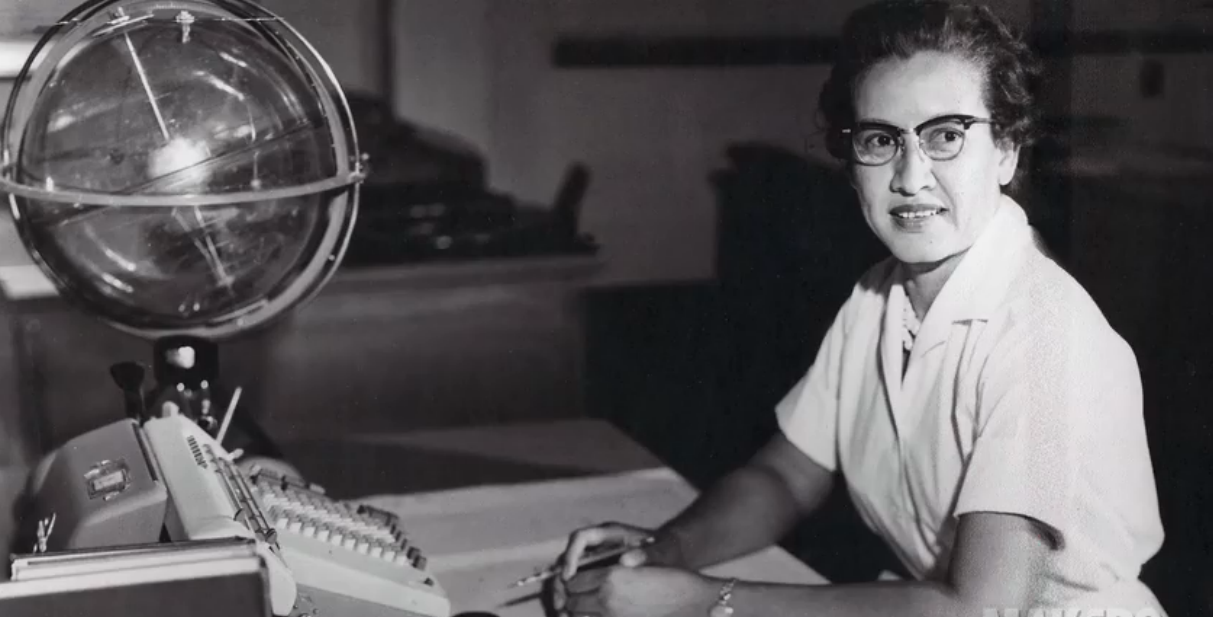
NASA photo of Katherine Johnson at her desk. Read NASA’s biography of Johnson for more about her life and work.
Teach an easy-to-remember routine: estimate, compute, hand-check
Use a three-step routine to turn Johnson’s story into practical math and fact-checking practice:
- Estimate. Before calculating, make a reasonable guess. Should the answer be closer to 10, 100, or 1,000? Is it likely to be more or less than the starting amount?
- Compute. Solve the problem and show the steps.
- Hand-check. Review the work another way. Try the inverse operation, use a different strategy, or ask whether the result fits the estimate.
This routine builds a useful distinction: an estimate is a quick reasonableness check, while a second method helps test the exact answer. A student who calculates (31 \times 4 = 84), for example, can estimate (30 \times 4 \approx 120). That’s a clue to look again. Multiplying carefully gives (31 \times 4 = 124).
For a history lesson, add one more question: What source supports this claim? A math problem can be checked with another operation; a historical claim needs reliable evidence. These related habits help kids learn that confidence is not the same thing as proof.

Try a “machine’s homework” challenge
Give students a short list of calculations with a few incorrect answers. Ask them to play the role of a human checker: estimate first, solve each problem, and identify the error. For example:
- (24 \times 6 = 144)
- (125 \div 5 = 25)
- (47 + 38 = 95)
- (31 \times 4 = 84)
Students can mark which answers need another look, correct them, and explain how they checked. The last two answers are incorrect: (47 + 38 = 85), and (31 \times 4 = 124).
Keep the story connection clear. The classroom exercise is inspired by the idea of checking calculations; it is not a reconstruction of Johnson’s actual work or Glenn’s flight calculations. For more character-led, evidence-minded elementary history resources, visit our lesson plans and character worlds.
Make a landing prediction with a ramp and marble
A simple marble-and-ramp test lets kids practise making predictions before they see what happens. It is a classroom analogy for thinking about a landing point, not a model of an actual spacecraft’s complex trajectory.
You’ll need a small ramp, a marble, a ruler, and a clear landing area. Have students predict whether the marble will travel a shorter or longer distance when:
- The ramp is raised to make it steeper.
- The marble starts halfway up the same ramp.
- A patch of carpet is placed where the marble lands.
Ask learners to write down a prediction before each test. After the marble rolls, they can measure the distance and compare the result with what they expected. Which variable changed? Did the prediction match? What would they measure or control to make the test fair?

This activity connects naturally to Johnson’s documented work predicting where a capsule would land. But it’s important to say exactly where the comparison ends: a marble ramp demonstrates prediction and testing; it does not reproduce the mathematics of orbital flight.
Put a real journey into a distance-rate-time problem
Johnson’s family drove 120 miles from White Sulphur Springs to Institute, West Virginia, so she could continue her education. NASA reports that schools for Black students in her hometown stopped at eighth grade. Her family made that long journey to give her access to further schooling.
This history belongs in the lesson as a real account of both Johnson’s determination and the unequal opportunities created by racism. It is also useful context to explain plainly that segregation was enforced at Langley during Johnson’s career. Black employees, including Black women mathematicians, worked in segregated spaces and under discriminatory rules. Segregation was unjust; it should never be softened or treated as a joke.
Then invite learners to solve a distance-rate-time problem using clearly labeled classroom assumptions:
- Assume the family drives 120 miles at 40 miles per hour. How long is the drive?
(120 \div 40 = 3) hours. - If they leave at 8:00 a.m. and stop for a one-hour lunch, what time do they arrive?
Three hours of driving plus one hour for lunch makes noon. - For a separate return-trip calculation, assume they drive the 120 miles at 30 miles per hour. How long would that take?
(120 \div 30 = 4) hours.
The 120-mile distance is the historical detail. The speeds, lunch stop, and example schedule are invented for the math exercise, not claims about how fast Johnson’s family drove or how long their trip took. Students can check the division with multiplication: (3 \times 40 = 120), and (4 \times 30 = 120).
Keep the characters playful and the history grounded
Character-led activities can make history feel inviting, especially for kids who learn best by doing. The key is to keep the boundary visible. Flicker the Firefly is a fictional guide inspired by Johnson’s documented work; Flicker did not meet Johnson, take part in the space program, or say anything on her behalf.
For a thoughtful discussion, ask students to sort statements into three groups: documented fact, classroom assumption, and fictional character detail. For example, Johnson’s contribution to checking calculations before Glenn’s flight is documented by NASA. The 40-mile-per-hour speed in the family-drive exercise is an assumption. Flicker is fiction. This simple sort supports the same big habit the lesson is meant to teach: pause, check, and ask what the evidence actually says.
That’s the heart of fun history lessons for kids: not just remembering a name or a date, but discovering how real people used their skills, and practising how to tell a fact from a guess. Read more in NASA’s Katherine Johnson biography and its profile of Johnson’s life and work.