How to Create a Homeschool History Curriculum in 5 Minutes a Day (Yes, Really)

A homeschool history curriculum doesn’t have to begin with a color-coded binder, a towering book list, or a heroic promise to teach for an hour every morning. For kids around ages 9–12, a small daily history habit can make the subject part of family life, and help facts stick.
Here’s the honest version of the “5 minutes a day” promise: five minutes is enough to keep a history thread going, not to replace every book, conversation, project, or full lesson. Think of it as a tiny daily anchor. Add a read-aloud or a longer activity when it fits, and you have a practical rhythm that can grow into a real curriculum.
Start with one question, not a giant schedule
Choose one broad topic or time period to explore, then give the week a question to return to. For example:
- What can an old object tell us about the people who used it?
- Why do accounts of the same event sometimes differ?
- How can we tell what a source supports, and what it doesn’t?
A question gives your history lessons for kids a purpose. It also keeps you from trying to cover every date, name, and civilization in one sitting. Pick a topic your child is curious about, sketch a simple timeline or map, and write down a handful of words you’ll encounter. That’s your starting framework.
You don’t need to plan a year in one go. Try a four-week theme, see what sparks questions, and adjust. A curriculum can be organized and still leave room for a fascinating detour. (History has plenty of those.)
Make five minutes count with a simple weekly rhythm
Use the same pattern each week, changing the topic and source. A repeatable routine means less planning for you and helps your child know what to do.
Monday: Meet a fact card. Share one clear fact about the week’s subject. Ask your child to locate the person, place, or event on a map or timeline. Keep it short: one fact is a starting point, not the whole story.
Tuesday: Tell a little story. Read a paragraph from a reliable book, retell a moment in your own words, or look at a short biography. Pause for one question: “What would you like to know next?” Keep historical people distinct from fictional guides and jokes. A playful animal character can introduce a topic; the character is never evidence about what really happened.
Wednesday: Notice a source. Look at one photograph, map, object, document, or excerpt. Ask, “What do you notice?” Before jumping to an explanation, give your child time to observe details.
Thursday: Make a careful claim. Invite your learner to finish the sentence: “I think this source shows…” Then ask, “Which detail makes you think that?” A claim should match the evidence, not race ahead of it.
Friday: Check and share. Revisit the week’s claim. Does the source support it? What remains uncertain? Your child might share a one-sentence summary, draw and label an object, or add a note to the timeline.
That’s five small touchpoints. If a discussion takes longer because your child has a terrific question, let it. The five minutes are a friendly minimum, not a timer that ejects you from the history table.
Teach one evidence habit: notice, claim, check
The most useful routine may be the simplest: notice a source, make a careful claim, check it again.
Try these three prompts:
- What do you notice? Start with visible or stated details.
- What can you claim from those details? Keep the claim modest and specific.
- What else should we check? Look for another source, missing context, or a question the evidence can’t answer.
This approach fits the Library of Congress’s guidance for working with primary sources: help learners observe, reflect, ask questions, and investigate rather than treating a source as a complete explanation. Its Getting Started with Primary Sources guide offers useful prompts for adapting source exploration to your learner.
For a first try, choose a picture or object rather than a dense page of old-fashioned writing. You might ask, “What do you see? What might it tell us? What can’t we know from this image alone?” The goal isn’t to make a 10-year-old a tiny professor. It’s to build the habit of asking what the evidence supports.
Add one longer session for the hands-on part
Five-minute routines keep history in view. A weekly 20–35-minute session can give your child more room to investigate, make something, or discuss different viewpoints. You don’t need a big craft supply haul. Try:
- Compare two short accounts of the same topic and notice what each emphasizes.
- Add three labeled events to a timeline.
- Draw an artifact and annotate what it can, and cannot, tell you.
- Make a claim-evidence-reasoning card: “My claim is… My evidence is… This matters because…”
- Create a meme caption for a historical situation, then check that the joke doesn’t distort the facts.
These are history activities for kids that combine creativity with thinking. Keep the evidence check in the activity: a funny caption is a response to history, not a historical source.
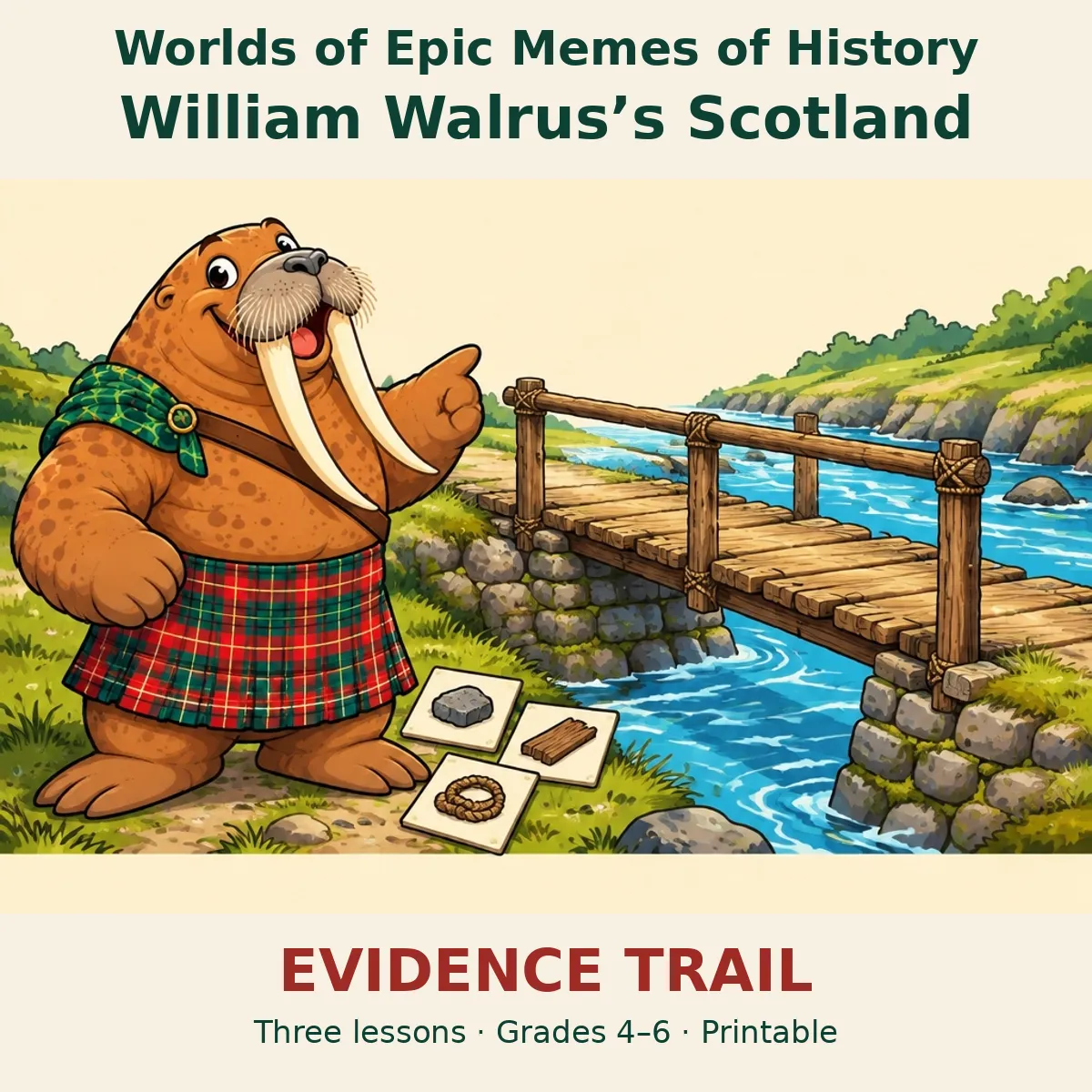
For example, William Walrus’s Evidence Trail uses three lessons to explore a battlefield record, an archive catalogue, and a later story about William Wallace. The walrus is a fictional sidekick, not William Wallace. The distinction is part of the learning: characters can make a lesson memorable, while sources do the work of supporting historical claims.
Make the plan easy to use again
A little structure saves a lot of “What should we do today?” Try a one-page weekly plan with these fields:
- Topic and question
- One key fact or short story
- Source to look at
- Claim to check
- One way to share what we learned
At the end of the week, keep one small record: a sentence, sketch, map note, or voice recording. Over time, those little records show your child’s growing knowledge better than a stack of worksheets left in a mystery pile.
If you’re choosing ready-made elementary history resources, look for materials that make the next step clear without locking you into a rigid schedule. A useful pack might include a teacher guide, reproducible student pages, story time, a creative Meme Lab, and a “Receipts” or sources page. Check whether the history claims are tied to sources and whether fictional characters are clearly labeled as fictional. Playful is great; confusing fact and fiction is not.
Try the method before you plan a whole year
You don’t need to build a complete homeschool history curriculum before you begin. Choose one question, pick one source, and try the notice–claim–check routine this week. If your child enjoys it, repeat the structure with a new topic.
You can browse Epic Memes of History’s lesson resources for printable investigations and take a look at the free history mysteries, where learners study clues, form a theory, and compare it with source notes. They’re an easy way to see whether evidence-first learning suits your family.
A short habit won’t cover all of history, and it doesn’t need to. Five minutes of noticing, wondering, and checking can make the next book, discussion, or longer activity more meaningful. Keep the routine light, follow your child’s curiosity, and let the evidence have the final word.